


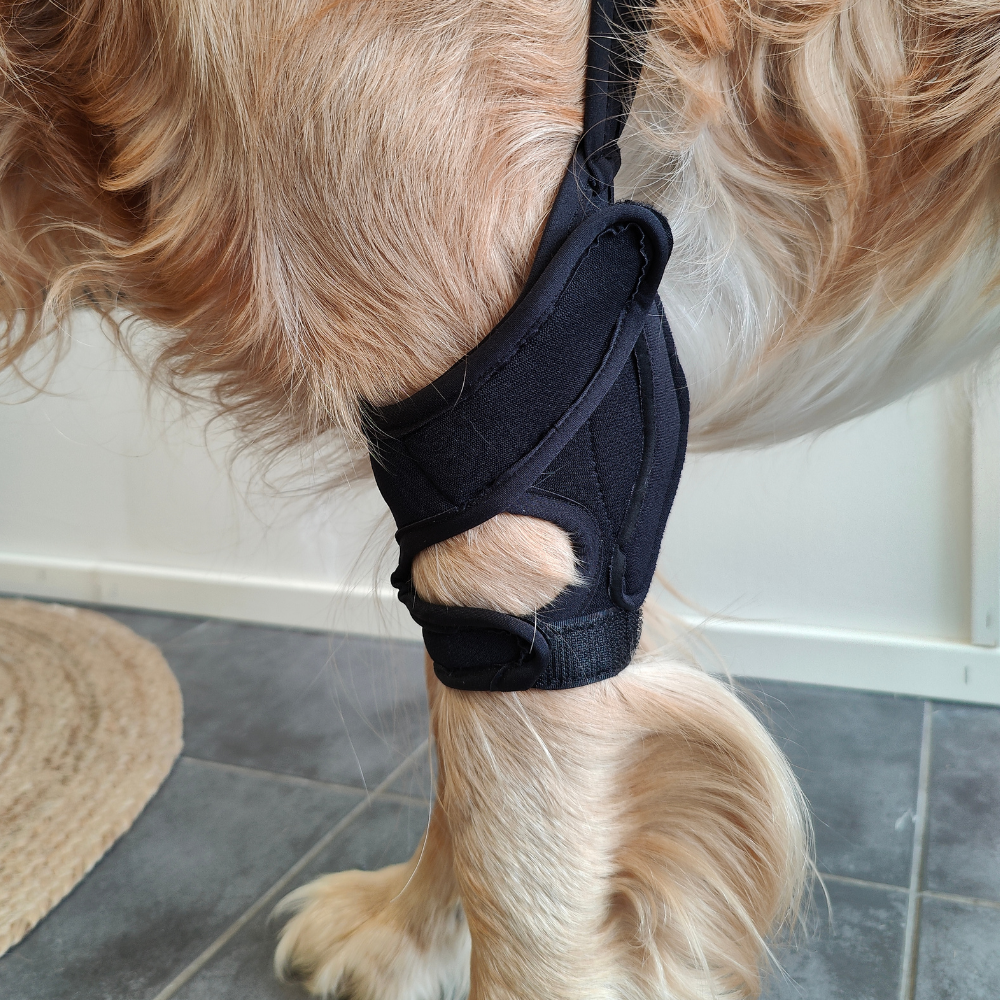
Elbow joint support
Elbow joint support
- For pain relief and to make walking easier
- To protect inflamed, dry and cracked skin
“My dog had been limping on her right front leg for about half a year, on and off. Especially after long walks of more than 5 km, she seemed sore the next day. Usually, whenever she got up from lying down, she appeared slow and stiff. Luckily, I tried the elbow brace for Mindi! The brace has stayed in place even when I leave it on her overnight, and now she walks much better. She’s also happier and eager to go for walks!”
Labrador Mindi, 12 years old, and her owner Kirsti
The Purpose of the Dog’s Elbow Brace
The elbow joint is formed by the union of three bones: the humerus, ulna, and radius. Common problems include growth disorders, fragments of cartilage breaking off, and osteoarthritis. Some dogs also develop sores around the elbow joint and a condition called bursitis, which is an inflammation of the bursa (fluid-filled sac).
The elbow bends and extends in all gaits, bearing weight as the dog moves. If the dog has trouble bending the elbow, it will move the leg cautiously and awkwardly, such as when climbing stairs. When lying down, the dog’s leg is usually slightly bent, and getting up after rest is difficult: the dog may limp and walk slowly for the first few steps.
When Your Dog Needs an Elbow Brace
You may notice your dog starts moving slowly, often holding the painful front leg slightly to the side, and its movements seem stiff. After just a few days, you may observe that your dog’s movements become more relaxed, and it finds it easier to get up.
Brace Usage Duration
It is common for joint issues to flare up occasionally, such as in cold weather. Use the brace when your dog has trouble with its leg. When movement becomes easy again, you can remove the elbow brace.
Note: Avoid throwing balls and sudden twisting movements, walking on hard surfaces like asphalt, and make sure to manage pain medication as needed.
How to Put on the Brace
Place the brace behind the elbow joint and fasten the straps around the chest, securing them on the back (behind the shoulder blades). Then adjust the brace so that the elbow joint is positioned in the stretchable and thinner section of the fabric. Fasten one Velcro strap above the joint and the other below the joint, ensuring the Velcro fastening remains on the outer side of the leg. The brace will typically mold to the shape of the leg and stretch as the dog moves. If the brace shifts below the joint when the dog is lying down, lift it back into place when the dog starts moving. Usually, the brace stays well in place when the dog is active.
Care Instructions for the Brace
The brace can be washed on a delicate cycle in a laundry bag or by hand with mild detergent. Often, cleaning can be done by wiping it down or removing hair from the Velcro fastenings. It is recommended to remove the brace during swimming.
Material Used
The fabric used in the brace is durable, padded, and flexible. The Velcro fastening uses genuine Velcro tape.